Through a Bent Pane
A short meditation on glass, light, and the rainbow fringe that lives at the edge of every lens — best read slowly, one line at a time.
Glass is a liquid that has forgotten how to move. It holds the shape we pour it into, then spends the rest of its long life pretending to be a solid, bending light instead of bending itself.
When you read through a curved pane, the letters beneath it do not simply blur. They migrate. Each ray of light that leaves the page is asked to take a detour, and the angle of that detour depends on how steeply the surface is sloped at the point where the ray happens to pass.
Near the flat middle of a lens, the detour is gentle and the text arrives almost where you expect it. Toward the edges, where the surface curls away, the rays are wrenched sideways and the words pile up on themselves, compressed into a bright, unreadable seam.
This is why the rim of a magnifying glass is the most interesting part. The center merely enlarges; the edge distorts, smears, and splits. It is honest about the fact that you are looking through a piece of bent matter and not through empty air.
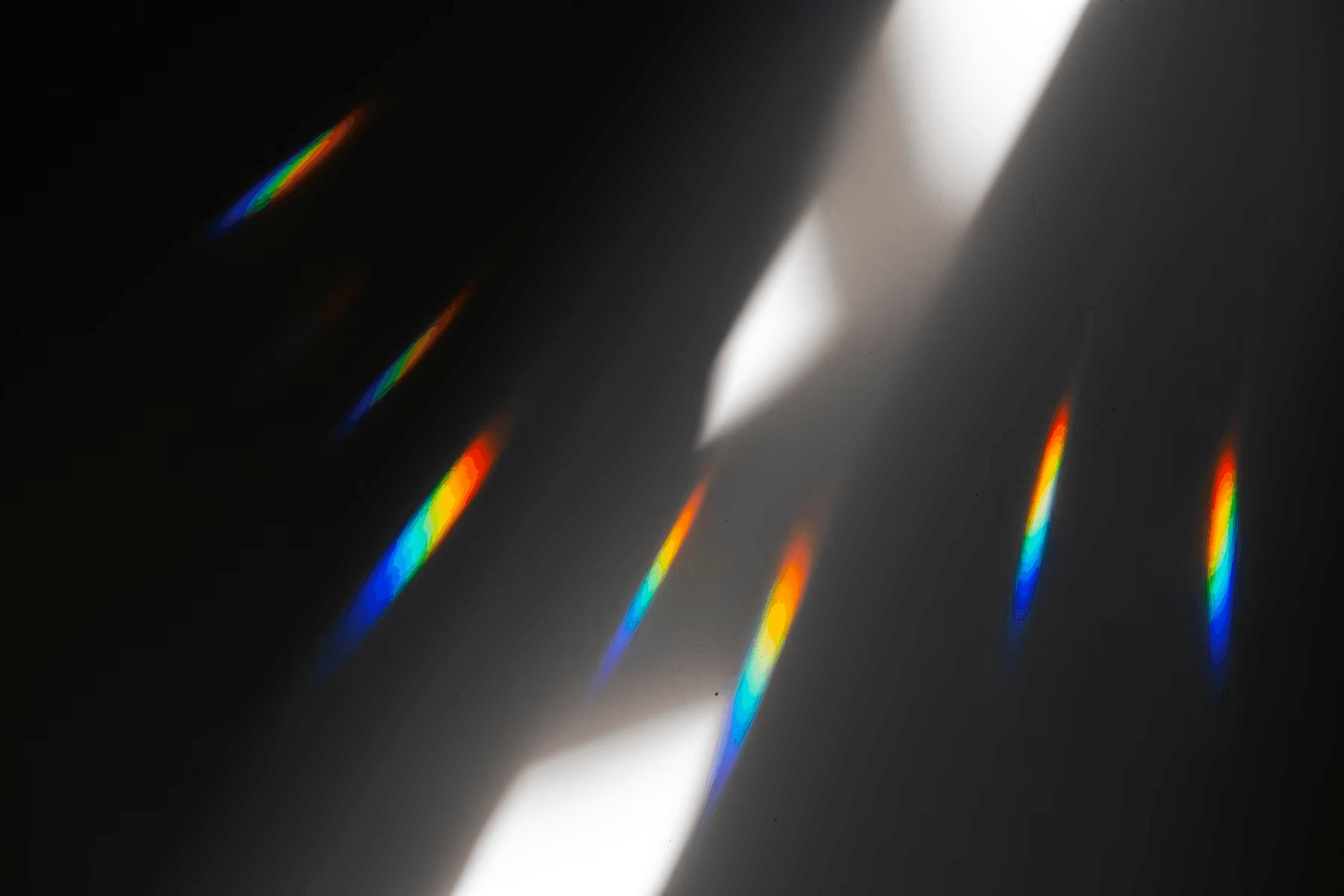
Color makes the distortion visible. White light is a crowd of wavelengths travelling together, and glass slows each wavelength by a slightly different amount. Blue is dragged back the hardest, red the least, and so the crowd fans out as it crosses the boundary.
We call that fanning dispersion, and its everyday signature is the faint rainbow fringe that clings to high-contrast edges seen through cheap optics. The same effect, tamed and exaggerated, gives a prism its spectrum and a diamond its fire.
Photographers spend fortunes trying to erase those fringes. Designers, perversely, spend just as much effort putting them back. A sliver of red on one side of a letter and a sliver of blue on the other is enough to make a flat screen feel like it has depth and weight.
There is something hypnotic about watching ordered text fall into disorder and climb back out again. As the page slides upward, a line of perfectly legible prose drifts into the warped band, stretches like taffy, scatters into color, and then reassembles below as if nothing had happened.
The strip never moves. It is the world that moves behind it. This is the quiet trick of all refraction: the glass does nothing but sit there, patient and transparent, while everything you try to look at is rerouted on its way to your eye.
Keep scrolling and you become aware of the rhythm of it. Sentences enter the lens from below, bow under the weight of the curve, and surface again at the top, briefly iridescent, before settling back into ordinary text on a dark page.
Notice how your eye refuses to rest inside the band. It skips across the distortion the way a stone skips across water, landing only on the calm text above and below, treating the warped region as a thing to be passed through rather than read.
That instinct is older than glass. We are built to find the edges of things, and a refracting strip is nothing but a moving wall of edges, each one promising a shape and then handing us a smear instead.
And yet we keep looking, because the promise is renewed with every line. The next sentence might be the one that survives the crossing intact. It never quite does, and that small, repeated disappointment is exactly what keeps the scroll going.
So let the words bend. Let them break into their colors and knit themselves back together. The page below is patient, the glass above is patient, and the only thing in a hurry is the reader, dragging the whole quiet machine upward one line at a time.